












 What is depreciation in accounting?
Depreciation allows organizations to allocate the cost of tangible assets over their useful life. This process is critical because it affects financial statements, impacts tax reporting, and ensures compliance with US GAAP. For lease accounting specifically, understanding how assets lose value is essential for calculating right-of-use assets and staying aligned with standards such as ASC 842 and IFRS 16.
To properly depreciate an asset under GAAP, accounting professionals must calculate the total cost of the asset, how long the asset will last before it must be replaced and how much an asset can sell for at the end of its useful life.
Types of depreciation methods
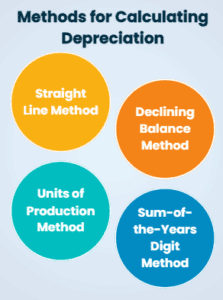
There are four methods for calculating depreciation:
- Straight line method
- Declining balance method
- Units of production method
- Sum-of-the-years’ digits method
Each of these depreciation methods are recognized under GAAP, and are suited to different types of assets and business needs. Let’s explore each in detail:
The straight line depreciation method
The simplest and most popular method of depreciation is the straight line method. This involves deducting the salvage value from the cost of the asset and dividing the resulting number by the asset’s useful life.
Straight line depreciation formula
Depreciation expense per period = (Cost – Salvage Value) / Useful Life
To illustrate this formula, let’s say a company buys a $15,000 machine with a salvage value of $4,000 and a useful life of 10 years. If the company in this example used the straight line method of depreciation, the annual depreciation cost would be $1,100.
The declining balance and double declining balance depreciation method
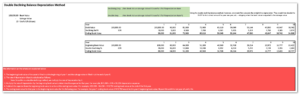
The declining balance method — a form of accelerated depreciation — allows an organization to depreciate an asset more heavily during its earlier years using a fixed percentage rate. The double declining method is a subset of the declining balance method, but as the name implies, it doubles the rate of depreciation.
These methods are most useful for assets that lose value quickly, such as vehicles, computers, cellphones or other technology.
Declining balance depreciation formula
Depreciation expense for a period = Beginning Book Value × Depreciation Rate
Double declining balance depreciation formula
Depreciation expense for a period = 2 x Beginning Book Value x Depreciation Rate
Units of production depreciation method
The formula for the units of production method is similar to that of the straight line method. But instead of using time to define the useful life of an asset, this method uses the number of units produced or hours of operation.
The units of production method allows organizations to deduct higher depreciation costs during years when an asset is used more or produces more units. For example, this may be utilized by a manufacturing company that used a specific piece of machinery to produce X units in 2022 but that will be phased out in 2023 so they will have a lower rate of depreciation next year.
Units of production depreciation formula
Depreciation expense for a period = [(Cost – Salvage Value) / Total Estimated Units of Production] × Actual Units Produced in Period

Sum-of-the-years’ digits (SYD) depreciation method
The most complex method is the sum of the years’ digits, which is another form of accelerated depreciation. This method provides a better indication of value for fast-depreciating assets. Because the depreciation formula for the sum of the years’ digits is difficult to calculate, it can present a cumbersome challenge for asset-heavy businesses.
Sum-of-the-years’ digits depreciation formula
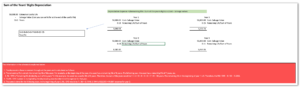
Depreciation expense for a period = (Cost – Salvage Value) × [Remaining Life at Beginning of Period / Sum of the Years’ Digits]
Sum of the Years’ Digits = n(n + 1) / 2
n = Useful Life in Years
Applying the right depreciation method under GAAP is not always straightforward, especially when calculations, compliance, and reporting all need to align. Visual Lease helps simplify the process of lease depreciation by reducing manual work, improving accuracy, lowering risk exposure, and giving your team a more efficient way to manage lease accounting.
Comparison of Depreciation Methods
|
Method |
Best For |
Complexity |
Depreciation Pattern |
| Straight Line | Long-life assets with steady value | Low | Even over time |
| Declining Balance | Technology, vehicles, quick obsolescence | Medium | Higher in early years |
| Units of Production | Machinery, manufacturing equipment | Medium | Varies with usage |
| Sum-of-the-Years’ Digits | Fast-depreciating assets | High | Front-loaded, declining |
Each method has advantages depending on the type of asset and business context.
Can you change depreciation methods from year to year?
The depreciation method can change from year to year, however it’s best to remain consistent to ensure compliance with the US GAAP standards. Proper documentation to demonstrate the change and justification must be provided.
Depreciation and its Impact on Lease Accounting
Accountants are responsible for figuring out the correct GAAP depreciation method to use based on which method will achieve the most satisfactory allocation of cost. Let’s look more closely at these methods and how businesses can apply them. Knowing when and how to apply these various depreciation methods in compliance with GAAP can be complicated. Leveraging an innovative software solution such as Visual Lease can help your organization streamline the process, eliminate risk exposure and save more on taxes.
Frequently Asked Questions About Depreciation
What is depreciation in accounting under US GAAP?
Depreciation is the process of allocating the cost of a tangible asset over its useful life. Under US GAAP, depreciation ensures that companies recognize the decline in value of fixed assets such as equipment, buildings, and machinery in a systematic and consistent way.
What are the four main methods of calculating depreciation?
The four primary methods recognized under US GAAP are:
- Straight-line method
- Declining balance method (including double declining balance)
- Units of production method
- Sum-of-the-years’ digits method
Which depreciation method is most commonly used by businesses?
The straight-line method is the most widely used, as it is simple to calculate and provides a consistent expense amount each year. However, companies may choose other methods based on the nature of the asset and how it generates value.
Can a company change its depreciation method after it has been applied?
Yes, organizations can change their depreciation method from year to year, but US GAAP requires proper documentation and justification. Consistency is preferred, but changes are permitted if they result in a more accurate reflection of asset use and value.
How do you find the rate of depreciation?
To find the rate of depreciation, calculate the percentage of an asset’s value that is depreciated each year. The simplest method is the straight-line rate, found by dividing 1 by the asset’s useful life.
How can software help manage lease depreciation calculations?
Lease accounting and asset management software, such as Visual Lease, simplifies the application of GAAP depreciation methods. It helps organizations automate calculations, maintain compliance, reduce manual errors, and improve visibility into the impact of asset depreciation on financial reporting.